UX case study · Nielsen's heuristics · 2026
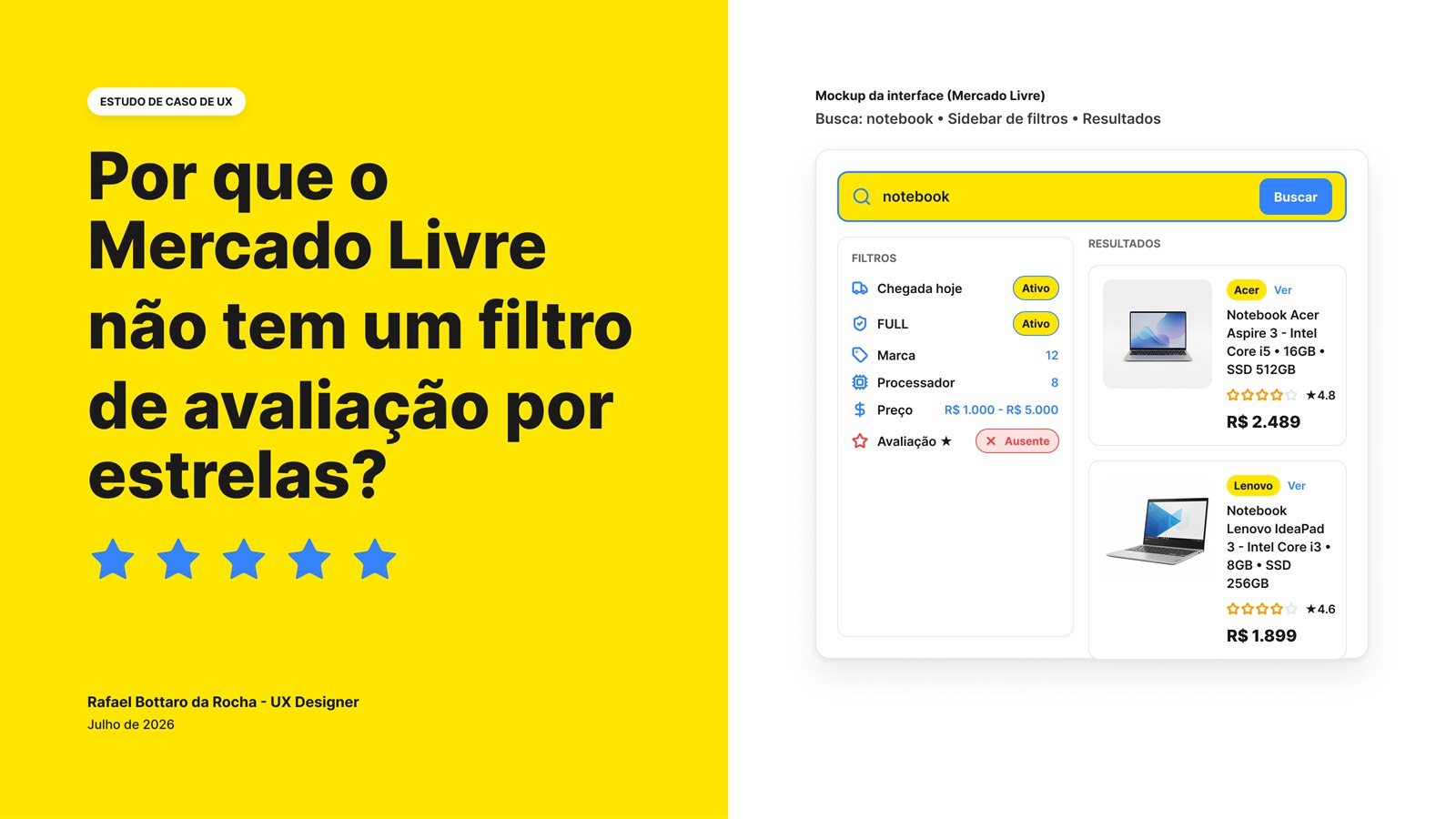
Why doesn't Mercado Livre have a star-rating filter in search?
An audit of Mercado Livre's search and filter flow, compared with Amazon. Everything here comes from direct observation of the interface or from public sources you can check.
The problem and the proposal
Problem. There's no “by rating” filter in search results. Product ratings (1 to 5 stars) exist and appear on result cards, but they can't be used as a search criterion.
Proposal. Design a rating filter that doesn't get in the way of the seller-reputation signal, with a safeguard for products with few reviews.
What the filter panel offers today
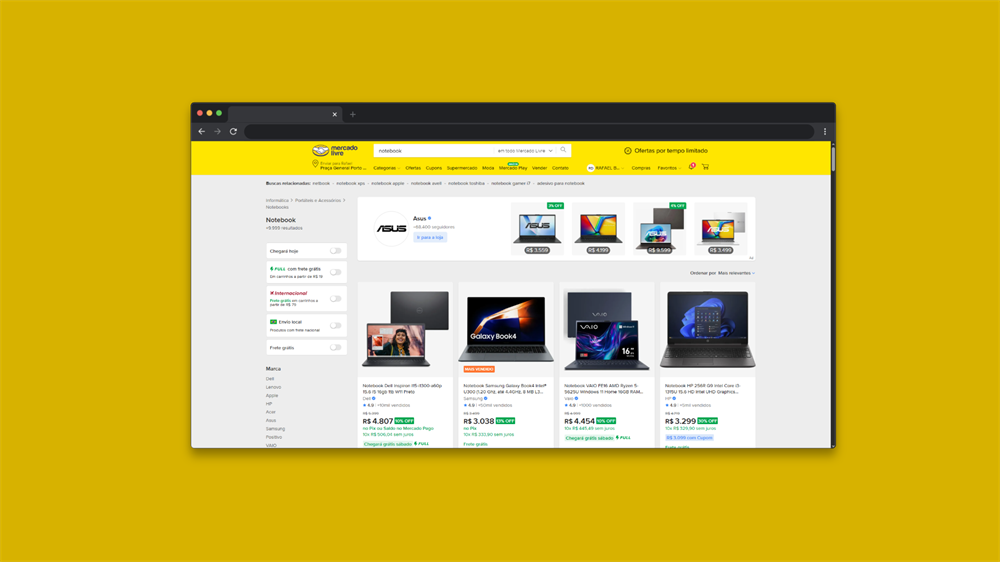
Live browsing on lista.mercadolivre.com.br/notebook, the Notebooks category, 9,999+ results (captured Jul 2026). I observed 21 filter groups, in the order they appear:
- Arrives today
- FULL with free shipping
- International
- Local shipping
- Free shipping
- Brand
- Processor line
- Condition
- Price
- Payment
- Discounts
- Delivery time
- Shipping origin
- Free pickup
- Official stores
- RAM capacity
- Operating system
- Use
- SSD capacity
- Screen size
- Total storage
- ✕ Rating (missing)
The rating exists, it just isn't a filter. Amazon's search panel has a “Customer reviews” filter, with options like “4 stars or more”, publicly documented by Amazon since 2013. It's not a hidden finding.




Confirmed facts
Mercado Livre doesn't publish an official explanation for this gap, so I separate what I could confirm (by direct observation or a public source) from what's just my own UX-reasoning hypothesis.
| Fact | Source |
|---|---|
| ML lets you rate a product 1 to 5 stars + a comment. | developers.mercadolivre.com.br · “Product opinions” |
| The average star rating appears on search cards. | Observed on lista.mercadolivre.com.br/notebook, Jul 2026 |
| There's no rating filter in search. | Observed · 21 filter groups mapped, none is “Rating” |
| Amazon has had a Customer reviews filter since 2013. | aboutamazon.com · customer reviews and star ratings |
| ML's catalog aggregates ratings from multiple sellers. | vendedores.mercadolivre.com.br · catalog competition |
Plausible hypotheses
- Catalog vs individual listings fragmentation. Not every product is in the Catalog system. “Identical” listings from different sellers can exist without a single unique identifier (like Amazon's ASIN), which makes a consistent star filter across them hard.
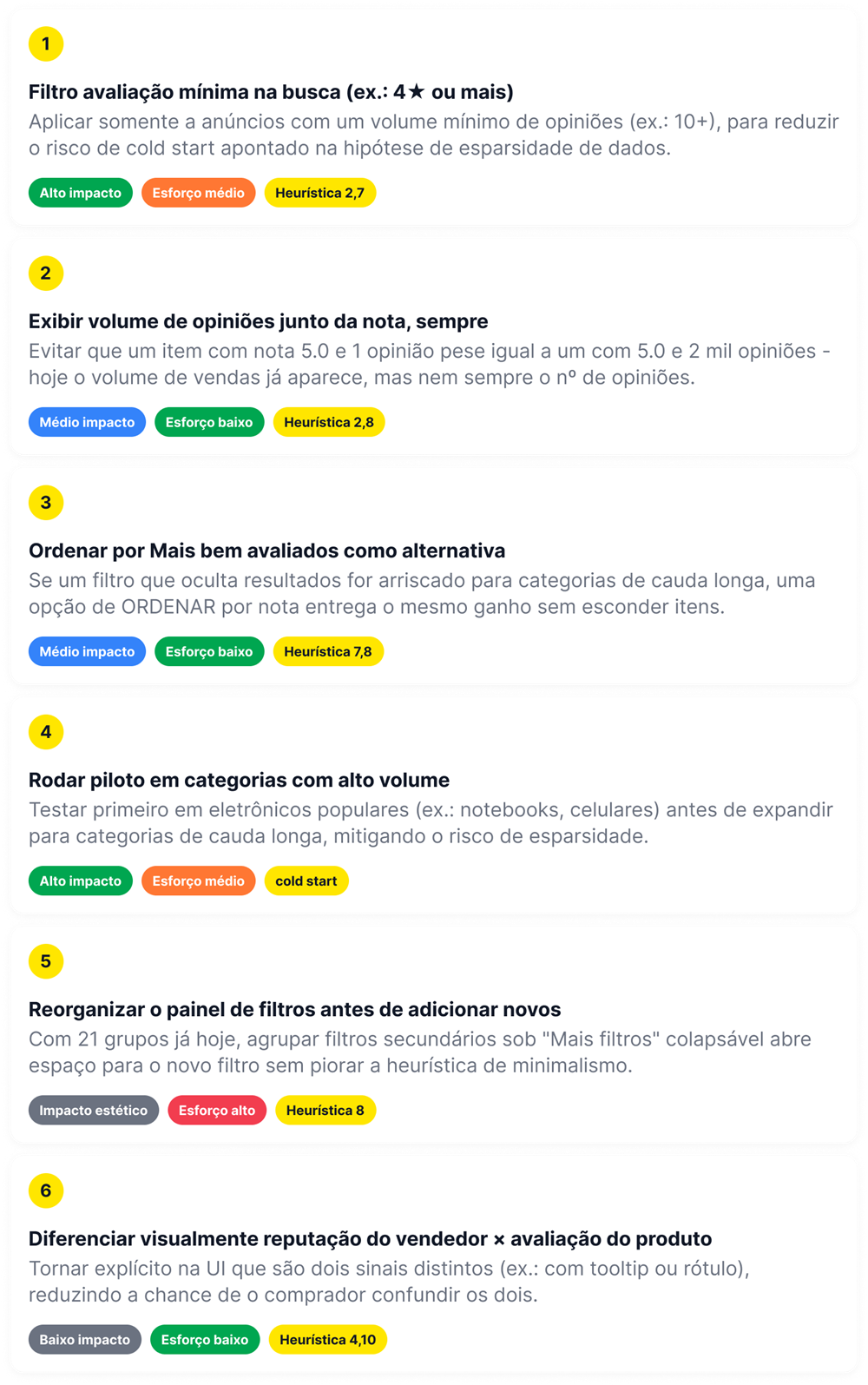
- Cold start. Many listings have few sales and few reviews. A star filter could return zero results in long-tail categories.
- Seller-trust model heritage. ML started as a peer-to-peer marketplace (like eBay) and invested in the seller-reputation meter as its central signal, unlike Amazon, with its retail heritage centered on the product.
- Panel overload. There are already 21 filter groups just for “Notebook” (heuristic 8, minimalism). Adding one more filter of uncertain use competes for space and attention.
- Risk of rating manipulation. A common hypothesis in the marketplace literature (not confirmed by ML): making a rating-based filter official would amplify the incentive for fake or paid reviews.
How the rating filter would look in the UI
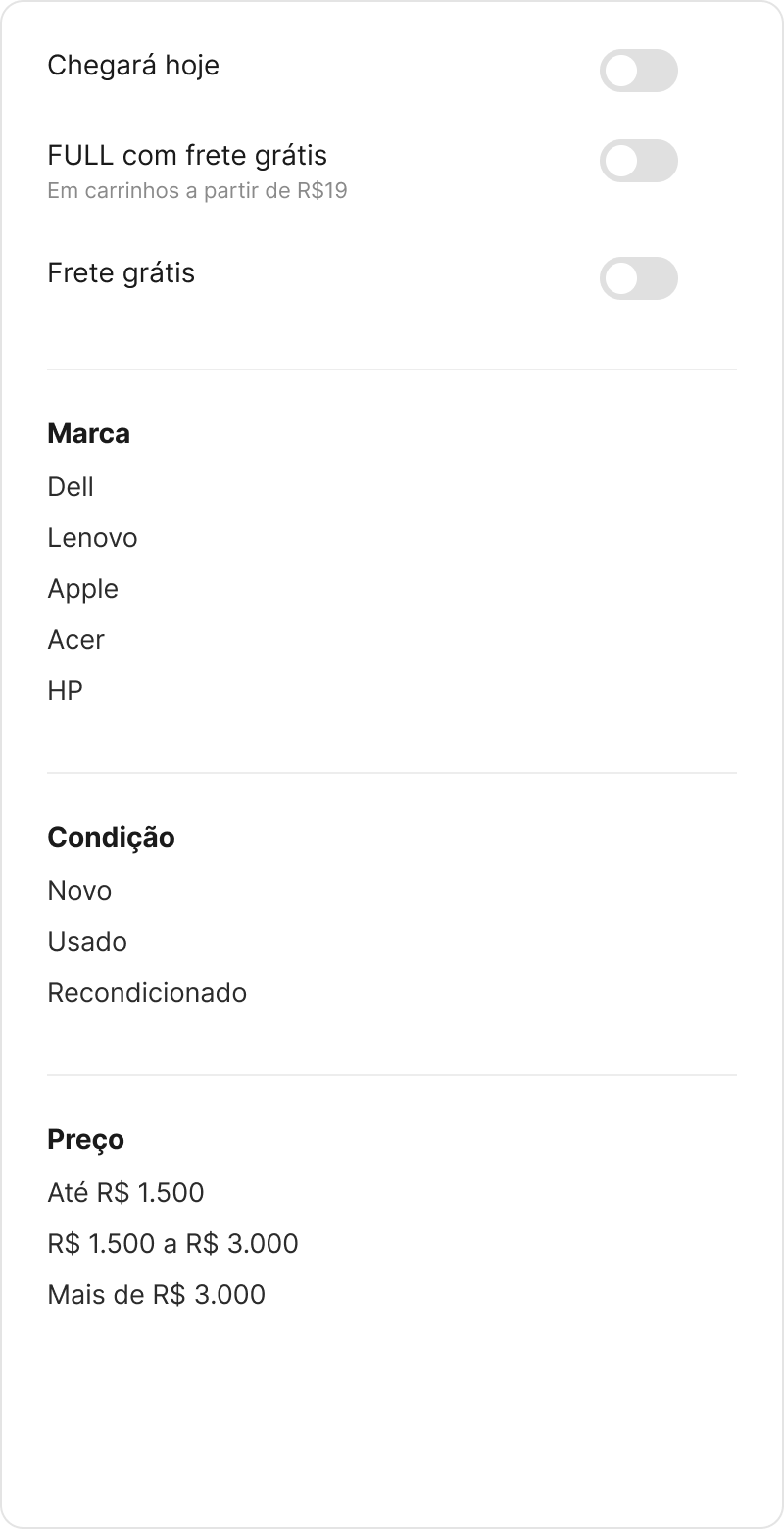
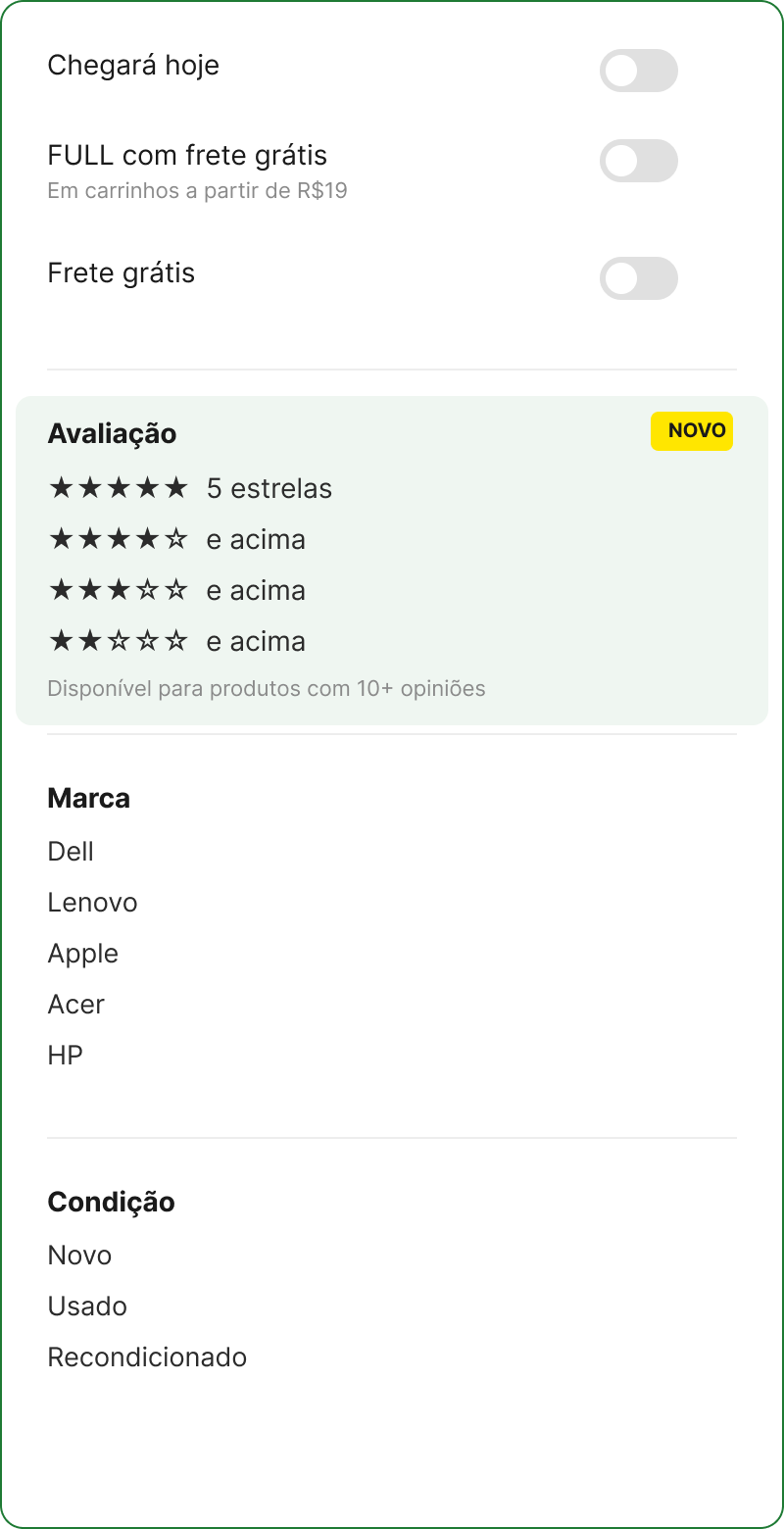
A quick, low-fidelity mockup using the same visual style as ML's current filter panel. The idea is to show where and how the filter would fit, not to finalize an interface spec.
- Placement: right after the delivery/shipping filters and before “Brand”, the same spot Amazon uses.
- Cold-start safeguard: the filter only appears for products with a minimum number of reviews (I thought 10+), so it doesn't empty out search in less popular categories.
- Consistent style: I reused the same option-list pattern already used in “Brand”, “Condition”, and “Price”, without inventing a new component.
None of this should go straight to production
This is the validation sequence I'd follow: qualitative research first, then a controlled test, always with a clear decision criterion set before starting.
- Goal
- Understand how people decide today whether “this product is good”, without a rating filter: seller reputation, sales volume, photos from other customers.
- Method
- 30-min moderated interview. Task: “find the best-rated notebook” in the current search, observing the path without leading the answer.
- Learning
- A signal that the missing filter is real perceived friction, or that users already solve it another way.
- Goal
- Compare the current panel with the panel that has the proposed rating filter.
- Method
- Moderated A/B test with a clickable Figma prototype. Same task: “find a notebook with at least 4 stars”.
- Metric
- Time on task, success rate, number of clicks, and post-task SUS, comparing the two panels.
- Goal
- Measure real impact, starting with the categories that have the most reviews (notebooks, phones) before expanding.
- Method
- 50/50 split in the pilot categories. Primary metrics: card → product-page click rate, and conversion rate.
- Guardrail
- Post-purchase complaint/return rate and average number of results returned per search.
- Goal
- Define what counts as success before the test, so the result isn't rationalized afterward.
- Rule
- If conversion rises or holds AND complaints don't rise → expand gradually. If the result count drops too much in the long tail → apply the filter only to products with 10+ reviews.
A gap that's an opportunity
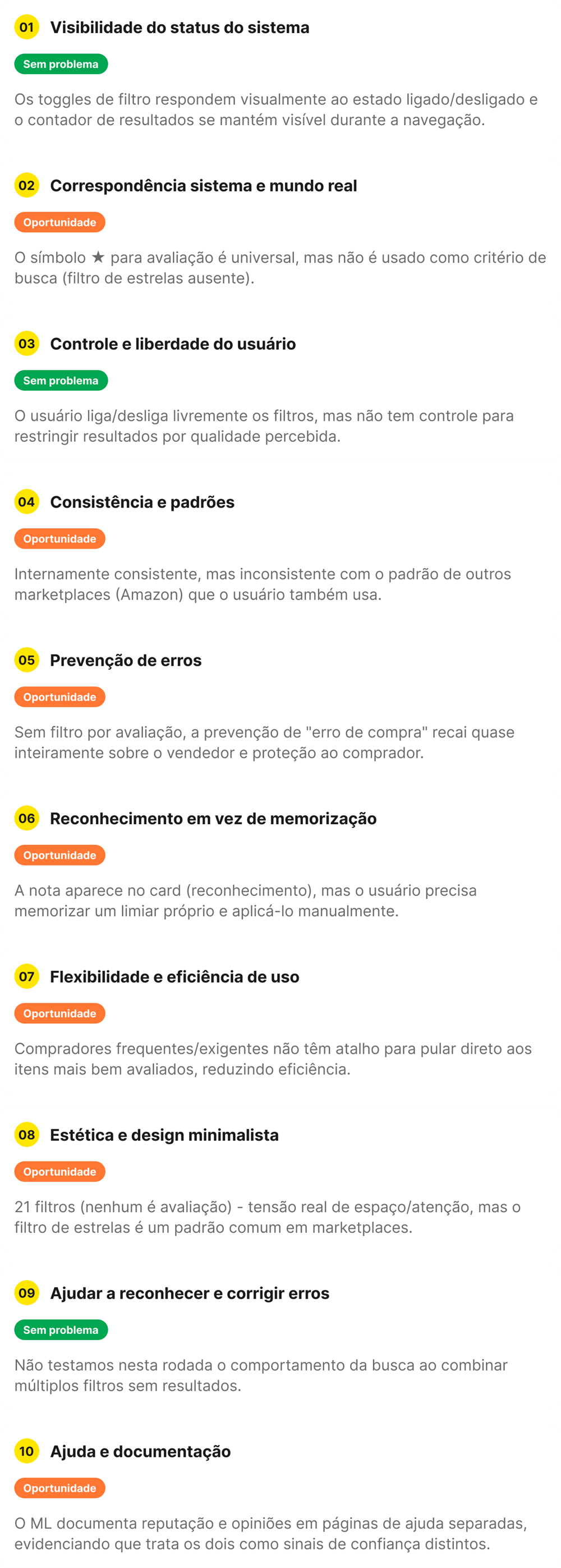
Mercado Livre already collects and shows product ratings, 1 to 5 stars, but it doesn't turn that into a search criterion, unlike Amazon. And this gap doesn't look like an oversight: the filter panel is already huge (21 groups just for Notebooks) and the site bets heavily on another trust signal, seller reputation.
Even so, I think the gap is a real opportunity. A well-thought-out filter, with safeguards against cold start and review manipulation, could add confidence at purchase time without fighting the reputation system that already exists.
Want the full analysis?
The Notion version walks through the 10 heuristics one by one, the before/after mockup, and all the sources.